Rethinking Localization in the Age of AI · Part 1
Localization Already Had Retrieval. So What Does AI Add?
Where RAG and LLMs add value to the localization systems we already have.
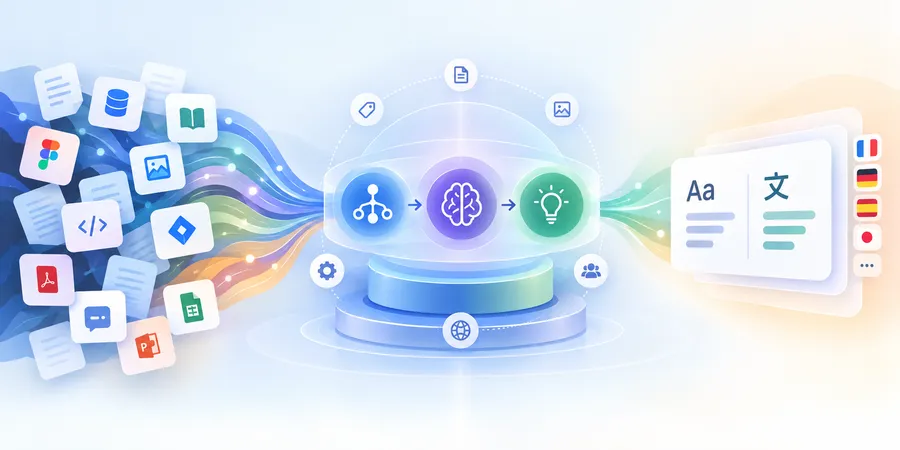
After more than a decade working with localization platforms, I wanted to try something from a different angle: building a RAG-based architecture using localization as the domain.
As I worked through the experiment, it prompted me to step back and look more closely at how localization platforms are evolving around AI. The more I looked, the more interesting the question became: if mature TMSs already retrieve linguistic knowledge, where does AI actually add value?
That question became the starting point for this series.
Localization has been retrieving context for years
A modern TMS rarely starts translation from a blank page. Translation Memory provides exact and fuzzy matches. Termbases provide approved terminology and business rules. Primary TM, background TMs, metadata, content types, matching thresholds, priorities and penalties can all influence what gets surfaced. That is already sophisticated retrieval.
RAG is a term that surfaced in my world in 2024. Localization has long practiced workflows that are similar in spirit to retrieval-augmented generation, even though a traditional TMS and modern RAG are not the same architecture. Traditional TMS retrieval is highly structured and often deterministic; RAG commonly retrieves heterogeneous evidence for a generative model. Retrieval itself is not new.
The story starts after retrieval
Consider a source segment as simple as:
Apply
A TMS may have a strong approved translation from previous projects. But “Apply” can represent very different actions depending on the product context: applying a filter, applying a discount, applying a setting, or applying for a service. The previous translation may be linguistically valid and still not be the right translation for the new occurrence.
The TMS has done something valuable: it has retrieved relevant linguistic history. The remaining question is how that history should be interpreted in the current context.
Imagine the new UI request in the TMS includes a screenshot showing that Apply is the button used to apply a set of search filters. A human linguist can look at the screenshot and immediately use that information when choosing the translation.
But whether the translation engine can use that screenshot is a different architectural question.
A conventional NMT engine receives the source text and whatever contextual signals its integration provides. It does not automatically gain the same visual understanding that the linguist has simply because a screenshot exists in the TMS.
If the TMS instead provides a textual explanation such as “This button applies the selected filters,” and that explanation is actually passed to the NMT engine as context, then NMT can use that information. The issue is therefore not that NMT cannot use context. The issue is what context is supplied to the engine, in what form, and how the engine can consume it.
A multimodal LLM could go a step further by receiving the source string together with the screenshot and reasoning over both. But that is a capability of the model and its integration, not simply a consequence of the screenshot existing somewhere in the localization workflow.
So the architecture is better described as:
retrieve
   ↓
interpret
   ↓
generate / adapt
Retrieval is evidence. It is not automatically the answer.
Not every localization problem needs AI
The fact that AI can interpret context does not mean every localization decision needs AI.
Many localization requirements are explicit and deterministic. For example:
- preserve this placeholder;
- use the approved product name;
- do not translate this brand term;
- use the required date format;
Traditional terminology management and automated QA already handle these effectively.
The more interesting cases are requirements that depend on meaning, situation, or interpretation.
Consider a style requirement such as:
Approachable and human: keep it conversational, avoid jargon, and let a little personality come through.
A traditional QA rule can check whether a required term appears, whether a placeholder was preserved, or whether a number is correct. But determining whether a translation actually sounds approachable and human is a different kind of problem. It requires evaluating the language against the intended context and the rule.
TMS vendors are beginning to turn that human-readable guidance into machine-usable instructions.
Phrase, for example, is moving style guidance into structured Rules, with eligible rules generating corresponding AI Checks for quality evaluation. Smartling similarly provides Style Rules for AI that can be used in translation and quality workflows.
The significance is not simply that an LLM is being added to QA.
It is that some guidance that was previously written for humans can now be expressed in a form a machine can evaluate.
Phrase’s documentation also makes an important qualification: adherence to individual rules by its AI Translation Agent remains probabilistic. Turning a style guideline into an AI-evaluated rule does not make the requirement deterministic.
So there are really two different kinds of checks:
Explicit / deterministic requirement
Traditional QA / terminology checks
        ↓
"Is the placeholder preserved?"
"Is the approved term used?"
"Is the date format correct?"
Contextual / interpretive requirement
AI-assisted evaluation
        ↓
"Does this sound approachable and human?"
"Does this follow the intended tone?"
"Does this translation fit the described context?"
This distinction matters because it tells us where AI is actually adding something new. The opportunity is not to replace deterministic localization controls, but to make more of the linguistic guidance around a translation available to machines in a form they can actually use.
So where does RAG fit?
Once we separate retrieval from how retrieved knowledge is used, the role of RAG becomes clearer.
A traditional TMS retrieves linguistic knowledge (TM matches, terminology, metadata, and other signals) and presents it within a structured translation workflow. A RAG-based system can use much of the same knowledge differently: instead of treating a retrieved translation as the answer, it provides that translation as evidence for a generative model.
Traditional TM

Source
  ↓
Retrieve match
  ↓
Candidate translation
Versus:
RAG-assisted generation

Source
  ↓
Retrieve relevant TM / TB / rules
  ↓
Provide context to the model
  ↓
Generate / adapt translation
Current products already show pieces of this model. Smartling’s AI Adaptive Translation Memory uses an LLM to optimize fuzzy matches between 50% and 99.9%. Lokalise’s AI Profiles can retrieve TM or reviewed project translations as RAG context for AI translation.
RAG does not eliminate the value of TM. It changes how TM is used: not as the final answer, but as evidence for generating or adapting a new translation.
Context quality matters as much as retrieval quality
Once retrieved information becomes input to a generative model, its quality and relevance become part of the generation problem.
A TM containing excellent translations for one type of content may not be equally useful for another.
For example, Lokalise’s AI Profiles documentation notes that mixed or inconsistent TM content can cause AI output to inherit the wrong tone or style.
This brings us back to the Apply example.
Suppose the TMS retrieves an excellent translation for Apply. The question becomes whether the reason it was good in the previous context also applies here.
A strong retrieval result is therefore not necessarily the right one. Its usefulness depends on why it was retrieved, where it came from, and whether that origin still applies to the current content. The harder problem is not finding a translation. It is understanding whether the retrieved knowledge is relevant here, and how it should be used.
The bigger question
RAG becomes interesting for localization not because retrieval is new, but because it gives a generative system access to organizational knowledge at the moment a decision is being made.
That knowledge can include TM, terminology and rules.
But the “Apply” example exposes a larger possibility.
The screenshot may be in the localization platform, the design spec in Figma, the implementation in GitHub, the feature requirement in Jira. The product behavior itself may be documented somewhere else entirely.
The localization system may know that the string exists, while another system contains the information needed to understand what the string actually does.
That leads to the next question: What if the context needed to localize something does not live in the TMS at all?
Next in the series: Context Engineering for Localization