The Reinforcing Loop Behind the AI Race
Three recent tech deals, Autodesk acquiring MaintainX, NVIDIA acquiring Hugging Face, and OpenAI launching GPT-6 Astra, reveal the same underlying pattern: reinforcing loops that make winning today easier tomorrow.
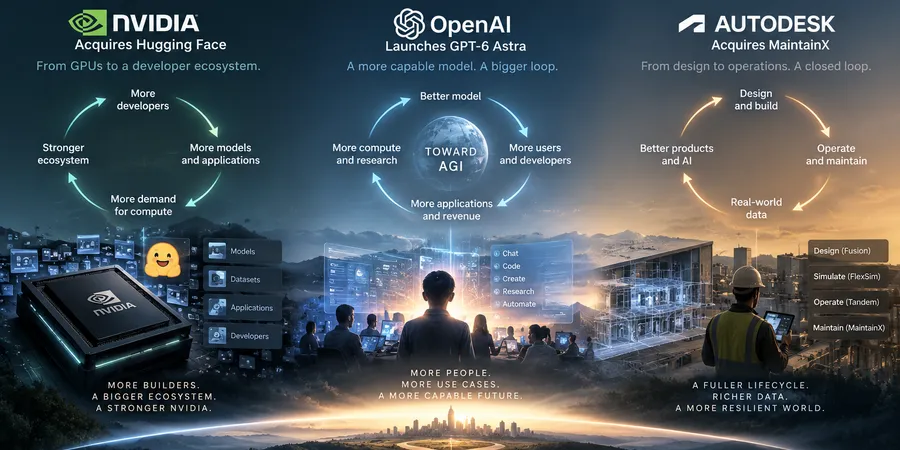
I’ve been thinking about three recent tech stories that, at first, seemed completely unrelated.
On May 28, Autodesk announced a $3.6 billion acquisition of MaintainX. Then, on September 3, NVIDIA agreed to acquire Hugging Face for nearly $13 billion, the same day OpenAI launched GPT-6 Astra and declared the beginning of the “AGI era.”
At first, these look like three completely different stories.
But I started seeing the same pattern underneath: reinforcing loops.
This reminded me of W. Brian Arthur’s book Increasing Returns and Path Dependence in the Economy, which I recently started reading.
The basic idea is surprisingly simple: in technology markets, an early advantage can create a feedback loop that makes the advantage increasingly difficult to catch.
More users → more ecosystem → more value → more users.
Autodesk’s MaintainX acquisition is a good place to start. Autodesk has traditionally been strong in design and engineering. MaintainX brings it deeper into the operational side, where maintenance workflows happen and real-world asset data is generated. Autodesk is essentially trying to connect design, make, and operate into one lifecycle.
NVIDIA’s Hugging Face deal looks similar from another angle. NVIDIA is moving beyond GPUs and deeper into the developer and open-model ecosystem. Hugging Face brings millions of developers, models, datasets, and applications into NVIDIA’s orbit.
And OpenAI’s Astra may represent another kind of reinforcing loop. A stronger model can attract more users and developers, which creates more usage, applications, revenue, and infrastructure. Those resources can then fund the next generation of models. OpenAI says Astra represents a major capability leap and the beginning of the AGI era, though the broader industry is still debating what that claim means in practice.
The interesting part is that the moat may not be the product itself.
The moat can be the loop surrounding the product.
That made me rethink how I look at technology companies. Instead of asking only:
“Who has the best product?”
Maybe the more important question is:
“Who is building a system in which winning today makes winning tomorrow easier?”
That, to me, is the fascinating part of Arthur’s theory, and perhaps one of the most useful lenses for understanding today’s AI and software industry.